The Impact of Adversaries on AI Adoption
Over the past few months, I've had some interesting conversations with companies on both sides of the US healthcare system - payors and providers. Both are aggressively pursuing AI to optimize claims reimbursements. The payor wants to pay as little as possible, and the provider wants the opposite. They're working with the same data, the same process, but they have completely opposing objectives. Neither side can afford to let the other gain an AI-driven edge in how claims are coded, submitted, reviewed, or appealed.
When I realized what I was seeing, I started finding the same pattern everywhere. We've started calling it Adversarial AI: the dynamic where AI adoption accelerates fastest when two entities have incentives that are diametrically opposed.
The Pattern
That healthcare dynamic isn't an anomaly - it shows up everywhere. Cybersecurity is the most obvious example: 82.6% of phishing emails now use AI language models, and the AI cybersecurity market is growing at nearly 25% annually because defenders have no choice but to keep pace with attackers. Litigation is another clear case. When one firm adopts AI tools that can process millions of documents in hours, opposing counsel can't afford not to match that capability.
Procurement is less obvious but just as real. Walmart used AI negotiation tools across 2,000+ suppliers, achieving 3% average savings, and suppliers are now responding with AI-optimized pricing and counteroffers. Both sides are arming up for the same conversation.
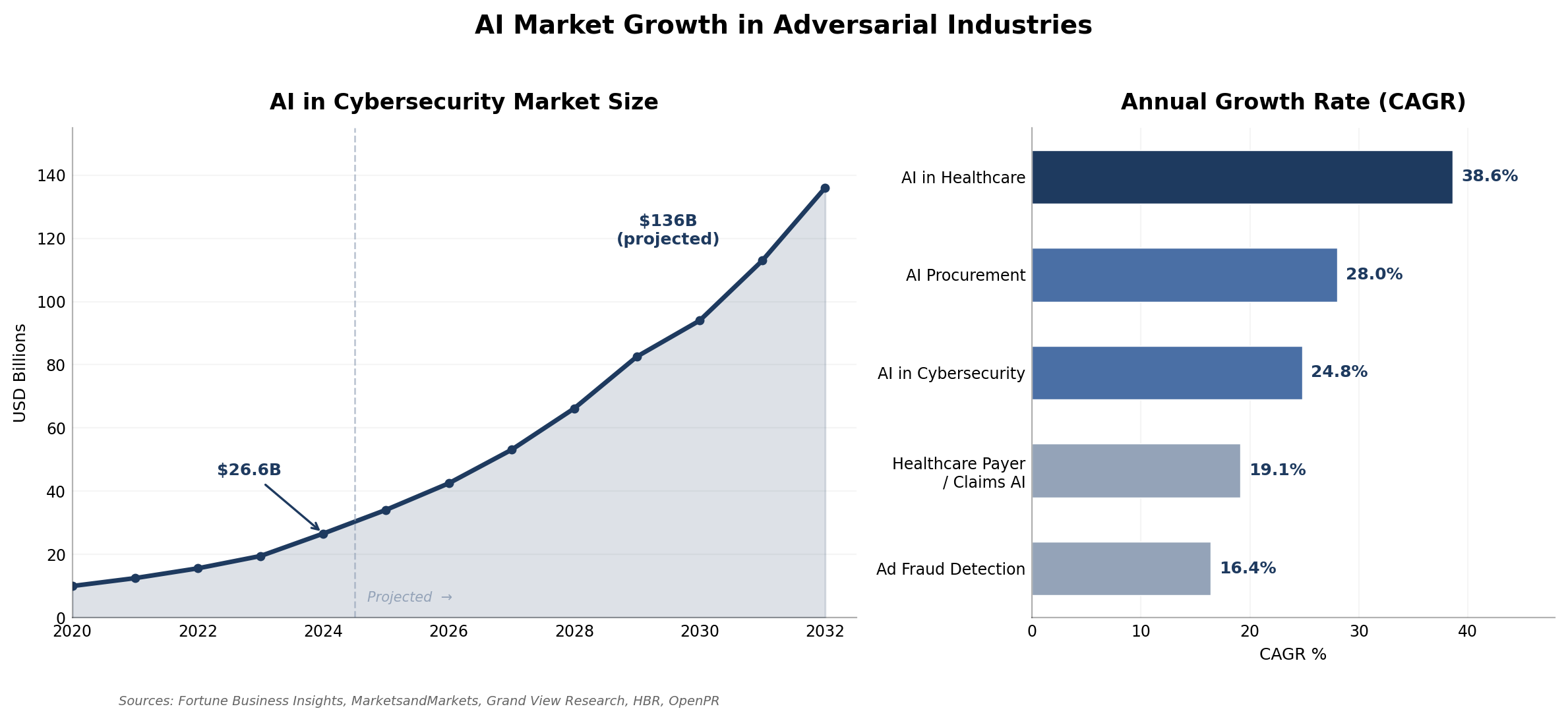
The IRS is deploying AI for audit selection and fraud detection, and accounting firms are responding with AI that optimizes filings and flags risks before the audit happens. Ad fraud follows the same pattern. AI bots mimic human behavior, platforms deploy AI detection to catch them, and the detection market is expected to nearly quadruple over the next decade because the opposing side forces the investment.
In every case, the adoption timeline isn't set by either party's readiness - it's set by the other side's actions.
Adversarial vs. Competitive
Not all competitive pressure is adversarial, though, and it's worth pulling these apart. When a competitor launches a better product or enters a new market, that's competition. You have time to evaluate, respond strategically, and decide whether to follow. Your adoption timeline is your own.
Adversarial dynamics are different. The payor and provider aren't competing for market share - they're on opposite sides of the same transaction, and every dollar one gains is a dollar the other loses. The same is true for attacker vs. defender, plaintiff vs. defendant, buyer vs. supplier. In these cases, the other party's AI adoption directly degrades your position.
Most AI roadmaps treat all use cases as roughly equivalent: evaluate the opportunity, estimate ROI, prioritize accordingly. But adversarial use cases operate on a different clock, and they deserve faster timelines and a different risk tolerance than internal optimization projects.
When Competition Becomes Adversarial
Pure competition can start to look adversarial, though, once AI adoption becomes visible. I spent years in digital transformation, and can't count the number of times a brand has told me they needed to build a native mobile app. When I asked why, the answer was almost always the same: their competitor had just launched one in the app store. Not because they'd done the strategic analysis, or because their customers were demanding it, but because they could see their competitors doing it.
AI creates the same pressure, but most of the time it's invisible. Whether a competitor is using AI to optimize their back office, accelerate underwriting, or sharpen pricing models is far less clear than an app listing. You might not know they have an advantage until you start losing deals and can't figure out why. That said, a resourceful leader can usually get some signal. LinkedIn alone can tell you a lot: is your competition hiring AI engineers or data scientists? Have their people changed titles to something AI-related? Are their executives posting thought leadership about AI transformation? These aren't definitive, but they're meaningful - and they’re freely available to anyone paying attention.
Microsoft's 2025 Work Trend Index found that almost a quarter of leaders worry that competitors are adopting AI faster than they are. You have to wonder what will happen if/when the adversarial dynamic bleeds into competitive markets.
This also reframes the current "death of SaaS" narrative. In February 2026, over a trillion dollars in software market cap was wiped out on the premise that AI coding tools would make software companies obsolete. The logic: if AI makes engineers dramatically more productive, companies need fewer developers. But that only holds if companies pocket the efficiency gains and cut headcount. In a competitive context, they may not. If AI lets your engineers ship twice as fast, your competitor might keep the same headcount and ship twice as much. Productivity gains become an escalation, not a reduction.
Getting Clear on Where You Stand
It's worth considering how your AI priorities shift when adversarial dynamics are in play. 88% of companies now use AI in at least one business function, up from 78% the year before. If your industry has adversarial dynamics, the window for measured adoption may be narrower than it appears.
This doesn't mean rushing in without a plan - governance, data strategy, and organizational readiness still matter. But it's worth asking whether your adoption timeline is being set by your own readiness or by your competitive landscape. Follow your competition closely, and pay particular attention to where you're in a truly adversarial environment - where the other side's gain is your loss. Those are the areas that deserve the most scrutiny and urgency.